From fast remote support to a custom-developed business application: on this page you will find each of
our services described in detail, with scope of work, process and all terms.
This page describes all eight Computer Heiler services in detail: scope of work, process and full terms. Billing is to the minute, with no minimum duration and no basic fee. For the three project services, a written estimate of the effort involved comes first instead of a list price.
Billing is to the minute, with no minimum duration and no hidden basic fees. For project services you receive
a written estimate of the effort involved in advance. Frequently asked questions are answered in our
FAQ on IT service and remote support; technical terms are explained in the
glossary of IT and AI terms.
Remote support
Remote assistance over an encrypted connection
€ 40 / hour
Most software problems can be solved without anyone having to drive out to you. With remote support
we connect to your computer after your express approval. You watch everything that happens on your
own screen the whole time and can end the session at the push of a button at any moment. All that is needed
is a working internet connection, remote support is available throughout Germany, not just in the
area around Kaiserslautern.
Personal data, passwords and banking details are not accessed. After the session, the
connection software is completely removed again. Further details are set out in our
privacy policy.
Terms: €40 per hour, billed to the minute.
No minimum duration, no basic fee. You pay only for work actually carried out.
Anything requiring physical presence (such as a hardware replacement), we handle in the on-site service.
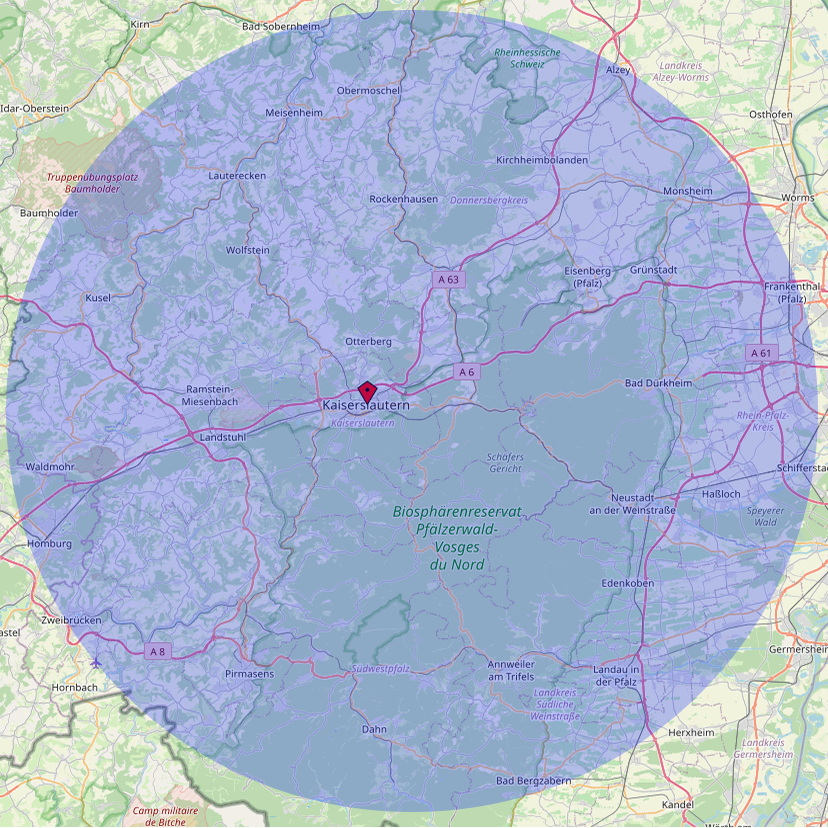
We come to you, within a 50 km radius of Kaiserslautern
€ 70 / hour + travel
Some things can only be done on site: replacing a faulty hard drive, adding memory, cabling a
network or rebuilding a computer that will not start at all any more. Then we come to you, at home, in the office or in the workshop.
Our service area covers a 50 km radius around Kaiserslautern, including Neustadt an der Weinstraße,
Pirmasens, Zweibrücken, Landau in der Pfalz, Rockenhausen, Kusel, Homburg (Saar), Landstuhl,
Ramstein-Miesenbach and Lauterecken.
When data has disappeared, every decision counts. We restore accidentally deleted files,
formatted drives, faulty hard disks and damaged databases, for Windows, macOS,
Linux as well as Android and iOS devices.
Every job begins with a preliminary analysis. In it we check the condition of the storage medium
and assess what can realistically be recovered. Only then do you decide whether we continue.
The chances of success depend on the type of damage and the condition of the medium. No reputable
provider can give a guarantee.
Important: do not switch an affected storage medium on
again and do not install any “recovery software”. Every further start-up attempt can reduce the chances of recovery
or overwrite data permanently.
What we deal with
Accidentally deleted files, formatted drives
Mechanically defective hard drives (HDD) and failed SSDs
Data loss after a virus infection or ransomware attack
Terms: €150 per hour. In addition there is a one-off
preliminary analysis fee of €100, which is non-refundable but is credited against the total price if the recovery succeeds.
For businesses that do not employ their own IT staff but still do not want to do without reliable
support: we look after your systems continuously, instead of only turning up
once something has already failed.
We define the scope and response times together and record them in writing. Maintenance contracts are
available in limited numbers, because we want to genuinely look after every customer, not merely
administer them.
Since 2023, large language models have fundamentally
changed the way we work with technology. The difference between a disappointing and an astonishingly
good result almost always lies in how the task is formulated, in the
prompt.
We develop reusable prompts for ChatGPT, Claude, Bard, Bing or Llama for you, show you
with your own tasks what the tools can do, and just as clearly where their limits lie. This
also includes image generation with FLUX,
Stable Diffusion, DALL-E and Midjourney.
Areas of application
Creative writing and storytelling
Personal assistants and business applications
Knowledge queries, learning and research
Artistic visualisation and graphics projects
Individual adaptation of existing prompts
Introduction to and training on AI tools
Terms: €20 per hour, billed to the minute.
Would you like to run your own model in-house? Then the route is via fine-tuning of open-source LLMs.
Not every business process can be sensibly mapped with standard software. Where industry solutions are too
rigid, too expensive or simply too cumbersome, we develop an application that maps your process
exactly, rather than the other way round, adapting your process to someone else’s software.
Custom software development has been part of our daily work since the early 1990s. In
that time, programming languages, databases and user interfaces have changed fundamentally several times over. The questions behind them have stayed the same: what should the program really do, who works with it,
and what happens to the data in ten years’ time?
We work in comprehensible milestones. After each stage you receive a working version,
clear documentation and the opportunity to reset priorities. The source code and the
rights of use for the solution created for you belong to you. You stay independent, including of us.
Integration of AI components where they bring benefit
Testing, documentation and supported commissioning
Maintenance, support and further development
How a project runs
1Initial consultation. Non-binding. We look at the process the software is meant to map and clarify whether an in-house development is the right way at all.
2Concept and effort estimate. You receive in writing what is to be built, in which steps, and what it costs.
3Implementation in milestones. After each stage there is a working version to try out, no waiting months for the big picture.
4Testing and commissioning. Data migration, training for your staff, documentation.
5Ongoing support. On request we subsequently take on maintenance, support and further development.
Terms: the scope, the technology used and the
depth of support differ considerably from project to project. For this service there is therefore
deliberately no list price. The terms are negotiated individually on a case-by-case basis. The basis is
always a written effort estimate following the initial consultation.
Editorial system with no online login, for blogs and news sections
Terms by agreement
Anyone wanting to maintain a blog or a news section normally installs a
CMS on the web server. That puts a login screen on the
internet, with user accounts, a database and usually a series of extensions as well, all software that has to be kept permanently up to date. This is precisely where the vast majority of attacks on
websites begin: at the login screen, at outdated extensions, at stolen credentials.
Our offline CMS turns the principle around. The editorial application is installed locally at your
premises and runs on your own computer, not on the server. You write your posts,
format them, insert images and see the preview without anything having to be online.
Only the finished post is published, over a transmission route set up specially for that purpose
and deliberately tightly restricted, which serves this purpose alone.
Afterwards, no editorial software runs on the web server. There is no
login screen, no user account and no database there that could be attacked. The published
website stays static, fast, frugal to run and without the regular security updates
that a classic CMS inevitably brings with it.
Your content remains entirely with you at all times, in a readable format on your own
computer. Even later, when the website is one day rebuilt or moved.
What it is intended for
Blogs and news or “latest” sections
Press releases and product announcements
Club and association websites
Reference and project reports
Individual authors and small editorial teams
Websites with heightened security requirements
What you get out of it
No login screen on the internet. The most common route of attack disappears
No CMS software on the server that has to be continuously maintained
No database on the server that could be compromised
Static website: short loading times, low server requirements
Posts are written offline, even without an internet connection
Transmission only over a specially set up, tightly restricted access route
Your content stays entirely in your hands
Setup, training and adaptation to your website layout
On the technology behind it: exactly how the offline CMS
works, how the transmission route is secured and how the whole thing fits into an existing website,
I prefer to explain in a personal conversation rather than on a public page. Give me a call or drop me
a short message. Then I will go through the method with you.
Terms: depending on the scope and on how far the
system has to be adapted to an existing website. The terms are agreed individually on a case-by-case basis, after a short conversation about your website and your editorial habits.
Your own language model, with your data, on your premises
Terms by agreement
Public AI services are convenient, but they have two catches: your data leaves the company, and the
model knows neither your terminology nor your internal processes. Both can be solved. Open
language models (open source or freely
available weights) can be run on your own hardware and retrained specifically for your use case.
We first assess soberly whether fine-tuning is the right lever at all. Often a clean
knowledge connection to your existing documents is enough, and that is considerably cheaper. Only when it comes to a fixed
writing style, recurring formats or specialist vocabulary is genuine retraining worthwhile, usually efficiently via LoRA/QLoRA rather than full training.
The result runs on a single GPU workstation or a small server at your premises. No
request leaves your network, there are no running costs per request, and you are not dependent on any
provider who might change prices, models or terms of use tomorrow.
Application examples
Internal knowledge assistant
A model that knows manuals, work instructions and project documents and points staff to the right place in seconds, instead of half an hour of searching the network drive.
Pre-sorting support enquiries
Incoming e-mails and tickets are automatically classified by topic, urgency and responsibility and supplied with a draft reply that a human only has to approve.
Terminology and house style
Quotes, reports and product texts in your terminology and your tone of voice, including the industry-standard abbreviations that general models regularly fail on.
Structured data extraction
Invoices, delivery notes, forms or inspection reports become usable data records that go straight into your database or ERP system.
Analysing confidential documents
HR, client or patient data must not leave the building. A locally operated model makes AI analysis possible even where cloud services are ruled out.
Connection to your business application
The model is integrated into existing software via an interface, on request together with a custom-developed application.
Models we work with
The choice depends on the task, the language and the available hardware, not on fashion. Among those that have
proved themselves are:
Llama (Meta)
Mistral & Mixtral (Mistral AI)
Qwen (Alibaba)
Gemma (Google)
Phi (Microsoft)
DeepSeek
Licence terms differ considerably from model to model, not every freely available model is open source in
the narrower sense or usable commercially without restriction. We check this before making a selection and record
the result in writing.
Scope of work
Feasibility check: fine-tuning, knowledge connection or none of the above
Model selection including licence review
Preparation and anonymisation of your training data
Fine-tuning (LoRA / QLoRA) and quantisation for your hardware
Measurable evaluation against the base model
Commissioning on your GPU hardware, training, documentation
Advice on suitable hardware
Retraining when new data and requirements arrive
Data protection: the entire process (data preparation,
training and operation) can take place entirely on your own hardware. Your data does not have to be transferred
to a cloud or to a third country. For the obligations that the
EU AI Act places on providers and deployers of AI systems,
we take transparency and documentation into account from the outset.
Terms: the volume of data, the model size and the target hardware
determine the effort involved. As with custom software development, the terms are therefore negotiated
individually on a case-by-case basis, after a feasibility check and a written effort estimate.
In most cases remote support. A computer that has become slow is rarely a hardware defect, but the result of too many auto-start programs, a full system drive, outdated drivers or malicious software. All of that can be analysed and fixed remotely. Only if it turns out that components need replacing, such as switching from a classic hard drive to an SSD, does it become an on-site appointment.
What does the on-site service cost including travel?
The on-site service costs 70 euros per hour, billed to the minute. On top of that there is a one-off travel flat rate per appointment: 20 euros within the city of Kaiserslautern, 25 euros up to 25 kilometres away and 30 euros between 25 and 50 kilometres. A two-hour visit in Landstuhl therefore costs 140 euros plus 25 euros travel.
Which services can be provided without an on-site appointment?
System analysis and clean-up, software installation and updates, setting up and checking data backups, virus and malware removal, configuring e-mail and browsers, as well as training and general computer questions. AI consulting and prompt engineering also run entirely remotely. Everything that requires physical presence, such as hardware replacement or network cabling, has to be done on site.
Why is there no fixed price for software development?
Because the scope, the technology used and the depth of support differ considerably from project to project. A small report over an existing database and the replacement of a legacy system that has grown over time, including data migration, have nothing in common. Instead of a list price there is therefore a non-binding initial consultation at the start, followed by a written estimate of the effort involved. The same applies to the offline CMS and to the fine-tuning of language models.
What happens with the preliminary analysis in a data recovery job?
Every job begins with a preliminary analysis for a one-off 100 euros. The condition of the storage medium is examined and an estimate is made of what can realistically be recovered. This fee is non-refundable, but is credited against the total price if the recovery succeeds. Only after the preliminary analysis do you decide whether to commission the actual recovery at the hourly rate of 150 euros.
Sources & references
The technical foundations of the services described here are documented, among others, in the following sources:
BSI for citizens: recommendations on data backup, malware and secure configuration.